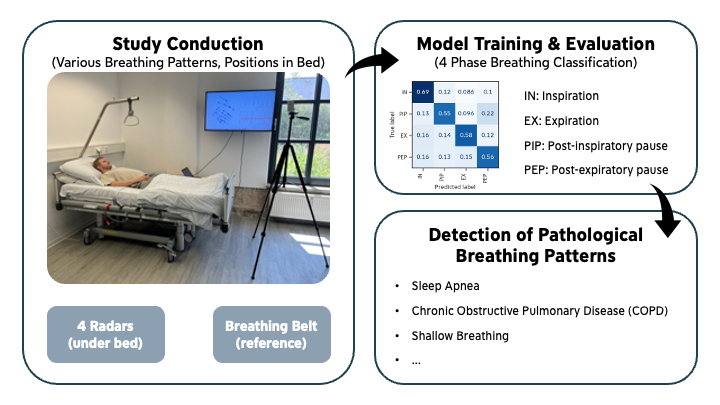
This project explores radar-based sensing as a non-invasive alternative to traditional respiratory monitoring methods, which often require physical contact or wearable devices that can disrupt patient comfort and sleep quality. Contactless monitoring holds particular promise for clinical environments where continuous observation is needed without interfering with natural breathing patterns or patient movement. By leveraging advances in deep learning, this research aims to extract detailed, temporal respiratory information from radar signals, enabling the detection and classification of both normal and pathological breathing patterns. The ultimate goal is to develop a robust system capable of identifying clinically relevant conditions such as sleep apnea and chronic obstructive pulmonary disease, contributing to improved diagnostic tools for respiratory care.
Requirements
- Strong background knowledge in biosignal analysis, machine learning, and deep learning
- Proficiency in Python programming language and familiarity with popular deep learning frameworks (e.g., PyTorch)
- English proficiency and independent working style
Tasks (dependent on project type)
- Reviewing the existing literature on breathing patterns and possible model architectures
- Training and evaluation of Deep Learning models for four-phase breathing classification (inspiration, post-inspiratory pause, expiration, post-expiratory pause)
- Applying the model to recordings with clinically recorded pathological breathing patterns (Sleep Apnea, Chronic Obstructive Pulmonary Disease, …)
- Documentation of the research process and insights in a comprehensive thesis/project report
If you are interested in working with us, please use the application form to apply. We will then get in contact with you.